Feed Tray Capacity Is Not the Same as Automatic Feeding
The Patty-O-Matic 330A, for example, is advertised with a 65-pound feed pan. Its product documentation identifies a feed tray, hopper assembly, and separate feeder components within the machine.
The Hollymatic Super uses a removable feed tray mounted above its hopper and compressor system. The manufacturer’s documentation describes this tray as safety-interlocked and lists it separately from the hopper bottom and internal compressors.
Those machines can form patties automatically, but the operator still has to pay attention to the product sitting in the feed area. The amount of meat visible on top of the machine does not necessarily represent a batch that can be loaded and then left alone until it has been formed.
That is where our design provides a meaningful operating advantage.
Load the Hopper and Let the Machine Feed Itself
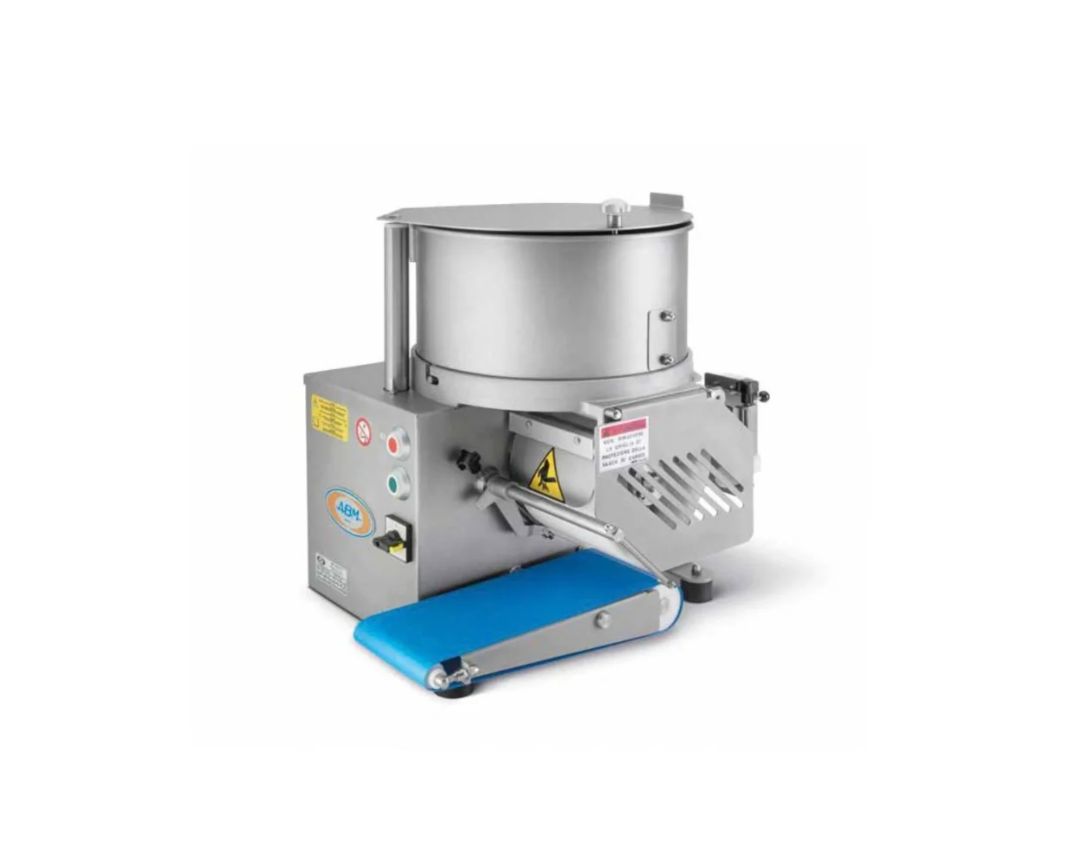
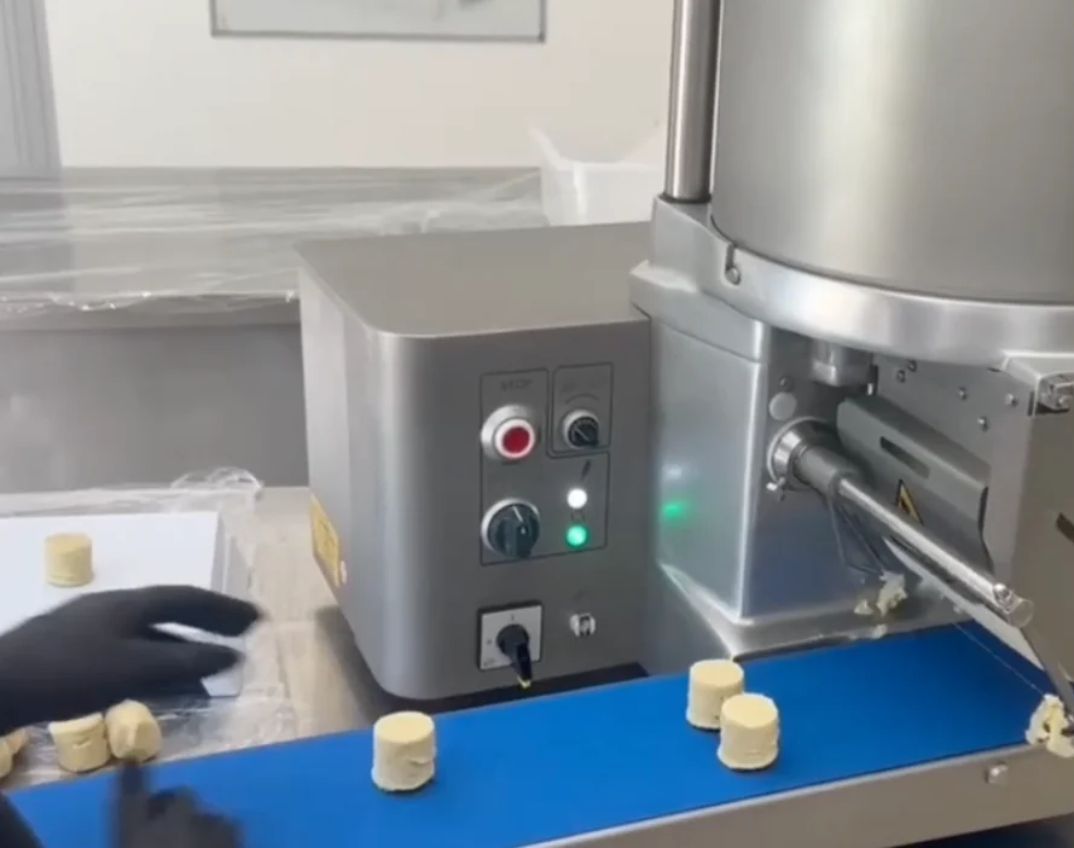
Our machines use an enclosed hopper designed to supply product automatically to the forming drum.
The operator loads a batch of ground product, closes the safety lid, and starts production. The hopper and internal feeding system then manage the product flow without requiring the operator to continually push, reposition, or direct meat into the forming mechanism.
This allows the operator to focus on the discharge side of the machine, where the actual work still needs to be done:
- Removing the formed patties
- Stacking or shingling them
- Placing paper between portions
- Loading patties onto trays
- Moving finished product into packaging
- Inspecting patty shape and consistency
- Preparing the next production batch
With a manually attended feed system, that same operator must split their attention between both ends of the machine. They must manage the product going in while simultaneously keeping up with the patties coming out.
Our machine eliminates much of that divided attention.
One Operator Should Not Have to Perform Two Jobs at Once
A patty machine may produce patties quickly, but someone still has to collect and organize the finished product.
If that operator must also continually monitor and manually feed the product tray, the machine creates competing responsibilities:
- Keep the feed area supplied.
- Move product toward the forming mechanism.
- Watch the patties coming off the machine.
- Stack, tray, or package each finished portion.
- Move back to the feed side before production is interrupted.
The issue is not simply inconvenience. Every time the operator turns back toward the feed tray, less attention is available for handling the finished patties.
By allowing the hopper to feed the forming drum automatically, our machines give the operator a clearer and more productive role: manage the finished product while the machine manages the incoming product.
The Hopper Lid Is a Safety Feature, Not a Production Limitation
The lid on our hopper can make the hopper appear smaller or less accessible than an open feed tray. In reality, the lid is there to provide a safer separation between the operator and the machine’s internal feeding components.
It is not intended to be opened every few moments.
The operator loads a practical production batch, closes the lid, and allows the machine to process that batch automatically. Because the product is not supposed to be continually manipulated by hand during operation, the enclosed design supports both safety and a more self-sufficient production process.
An open feed area may look larger, but an enclosed hopper that moves product on its own can require far less operator attention.
Compare Unattended Run Time, Not Just Hopper Dimensions
When evaluating patty formers, customers should look beyond the published hopper capacity and ask more practical questions:
- Does the machine automatically deliver product to the forming system?
- Must the operator push or reposition product while the machine runs?
- Can the operator remain at the discharge end?
- How frequently must the operator interrupt patty handling to manage the feed area?
- Can one person realistically collect and package patties while keeping the former supplied?
- How much of the loaded batch can the machine process without operator intervention?
These questions describe the real production experience much better than hopper dimensions alone.
A large open feed tray may hold more product on paper. But if the operator must continually manage that product, its apparent size does not necessarily translate into reduced labor.
Choose the Right Hopper for Your Batch Size
Our product line also gives customers options based on their production requirements.
F1000
The F1000 provides automatic feeding in a compact patty-forming system. It is ideal for operations that run practical batches and want the machine to manage product flow while the operator handles the finished patties.
F2000
Customers processing larger batches can move up to the F2000. The additional capacity allows for longer production runs while maintaining the same fundamental advantage: the machine feeds product to the forming drum instead of depending on the operator to do it manually.
F2000 With Extended Hopper
For operations seeking even longer unattended production periods, the F2000 is available with an extended hopper. This configuration increases batch capacity and further reduces the frequency of reloading.
The extended hopper is especially useful for customers who want to:
- Run larger batches
- Minimize loading interruptions
- Keep the operator focused on packaging
- Support longer production runs
- Increase output without adding another employee simply to manage product feeding
This creates a clear progression. A customer can choose the compact F1000, move up to the F2000, or select the F2000 with an extended hopper based on production volume and desired batch size.
The Most Useful Hopper Is the One That Requires Less Attention
The purpose of a patty former is to reduce manual labor.
That benefit is limited if the operator must continually stand over the machine and manage the product being fed into it. A machine may form patties automatically, but it is not delivering a fully efficient workflow if someone still has to babysit the feed tray.
Our hopper is designed differently.
Load a batch, close the safety lid, and let the machine supply product to the forming drum. The operator can then concentrate on collecting, stacking, traying, or packaging the patties.
That is the comparison that matters. Not simply which machine appears to have the largest opening or feed tray, but which machine requires less operator attention once production begins.
Let the Machine Handle the Feeding
Our hopper may sometimes be described as smaller than the open feed areas found on competing machines. However, capacity should always be considered alongside function.
A large feed tray that requires ongoing operator involvement is not necessarily more productive than a properly sized hopper that feeds itself.
With the F1000, F2000, and F2000 extended-hopper configurations, customers can choose the batch capacity that fits their operation while gaining the same central advantage:
The machine handles the feeding, so the operator can handle the finished product.